Descriptions of practices here are historical and educational, not personal instruction or health advice.
Life
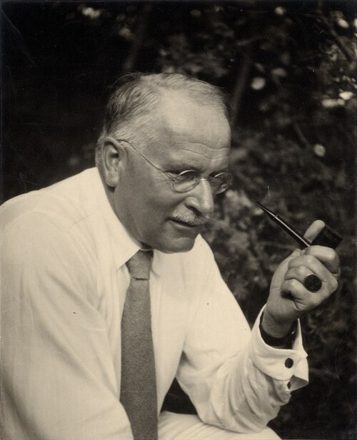
Jung was a Swiss psychiatrist who worked closely with Freud before their break around 1913, after which he developed analytical psychology. He held that beneath the personal unconscious lies a collective unconscious shared by humanity, structured by archetypes, and that psychological growth is a lifelong process of individuation toward wholeness. He studied alchemy, Gnosticism, Eastern religions and astrology seriously, reading alchemical symbolism as a language of psychological transformation, and he wrote the foreword to the English edition of Richard Wilhelm's I Ching, where he discussed synchronicity.
The system
- The collective unconscious and archetypes (shadow, persona, anima/animus, Self).
- Individuation: integrating conscious and unconscious.
- Synchronicity: meaningful coincidence.
- Psychological types: introversion/extraversion and four functions.
Key works
- Psychological Types (1921)
- Psychology and Alchemy (1944)
- Foreword to the Wilhelm/Baynes I Ching (1950)
- The Red Book (published 2009)
- Memories, Dreams, Reflections
Where to start
- Man and His Symbols (written for general readers).
- Memories, Dreams, Reflections (autobiography).
Ask Orin
A question to start with. It opens in Orin ready to edit; nothing is sent until you press Send.
How does Jung's synchronicity relate to consulting the I Ching?Ask Orin this question