
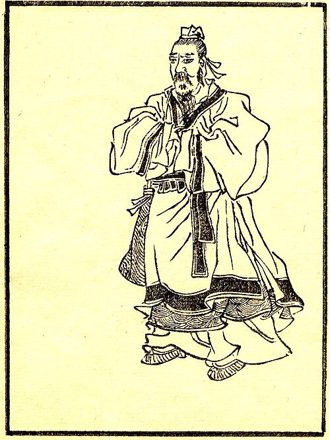
Life
Guo Pu, styled Jingchun, lived at the turn of the Western and Eastern Jin. He was a leading scholar and poet whose commentaries on the Erya, the Shanhai jing and other ancient books are still standard references, and whose 'Poems on Wandering Immortals' are well known. He was also famed as a diviner. Later tradition credits him with the Zangshu (Book of Burial), whose line 'qi rides the wind and scatters, and stops at the boundary of water' is taken as the origin of the term fengshui; most scholars, however, regard the surviving text as a later work attributed to him. He was executed in 324 after advising the general Wang Dun against rebellion.
The system
- Qi gathers where wind is sheltered and water bounds it.
- Source of the 'forms' school, judging sites by landforms.
- A scholar's method joining divination, geography and textual commentary.
Key works
- Zangshu (Book of Burial, attributed)
- Commentary on the Erya
- Commentary on the Shanhai jing
- Poems on Wandering Immortals
Where to start
- Begin with a general history of fengshui that covers Guo Pu and the attribution question, then read the Zangshu itself.
Ask Orin
A question to start with. It opens in Orin ready to edit; nothing is sent until you press Send.
What does 'qi scatters with the wind and stops at water' mean in fengshui?Ask Orin this question